Department of Earth Sciences
Service Navigation
About AIMS (Analogue Icy Moon Simulations)

The Analogue Icy Moon Simulations (AIMS) project, funded by the European Research Council, investigates the physicochemical conditions in the subsurface of icy ocean worlds like Saturn’s moon Enceladus. This small moon is home to diverse chemistry across various regions, and is considered amongst the most likely locations where extraterrestrial life could reside in the solar system. AIMS studies chemistry that can occur in high-pressure and high-temperature regions in the depths of Enceladus’ ocean, how chemical species are modified as they travel from ocean floor to surface, and what spacecraft sampling of Enceladus’ cryovolcanoes can reveal about habitability.
Dr. Nozair Khawaja (left picture) was awarded a Consolidator Grant by the European Research Council for a five-year research project - Analogue Icy Moon Simulations (AIMS) - at Freie Universität Berlin. In this project, Dr. Khawaja and the AIMS team will investigate physicochemical subsurface processes of Saturn’s plume-bearing icy moon Enceladus and how they might relate to habitability.
The geologically active icy moon Enceladus ejects subsurface material from its south pole into space in a plume of gas and ice grains. NASA’s Cassini spacecraft, which investigated the Saturn system between 2004 and 2017, captured and analysed plume material revealing deep-ocean hydrothermal systems, a porous, water-filled rocky core, and a large, diverse inventory of chemical species in its subsurface. Cassini detected these species in ice grains sampled directly from the plume as well as in Saturn’s E ring, which is a depository for Enceladean ice grains. Chemical species may be sampled by spacecraft in the plume and E ring, but many traverse a long journey through the subsurface prior to their detection. From their time under high-temperature and -pressure conditions within fluid inside the core, during their ascent through the ocean toward the surface, and finally their ejection into space, these compounds evolve chemically. To understand the chemistry observed by Cassini and future missions, these processes must be simulated in the laboratory.
The goal of ERC-AIMS project is to determine just how well these ejected chemical species reflect the composition of Enceladus’ ocean and the hydrothermal vents at the ocean-core boundary. To achieve this aim, the evolution of a variety of chemical species at shallow core depths and in the bulk ocean will be simulated using a series of interrelated experimental facilities. The chemical analysis of these species will be performed by various analytical techniques used in conventional chemistry - e.g. spectroscopy and mass spectrometry. Conclusions drawn from these laboratory simulations will be used not only for the better interpretation of mass spectrometric data from Cassini, but also the planning of future space missions toward Enceladus (e.g. ESA’s L4 mission), as well as the ongoing JUICE and Europa Clipper missions to the Galilean moons of Jupiter.
Simulating the Life Cycle of Chemical Species from Core to Plume
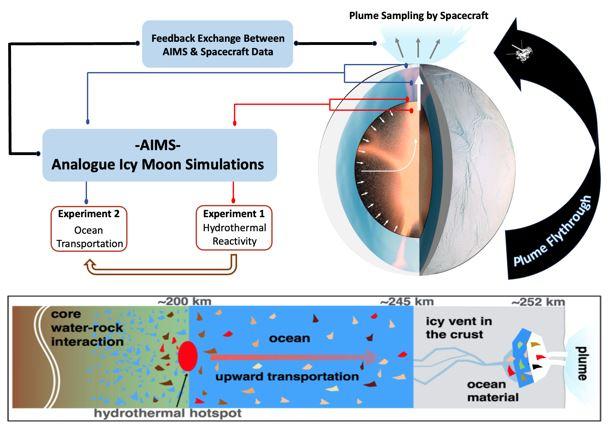
Image Credit: ESA/Choblet et al. 2017 adapted from Hsu et at. 2015
Team:

Dr. Nozair Khawaja is a research group leader at Freie Universität Berlin. He is a planetary scientist and a research group leader with the AIMS ERC Consolidator Grant. Khawaja’s expertise also includes the characterisation of cosmic dust that emerges from different environments in the solar system using spaceborne mass spectrometers and laboratory investigations. He is a co-investigator on the DESTINY+ Dust Analyser onboard JAXA’s DESTINY+ mission to the dust-emitting asteroid 3200 Phaethon. He is also a science team member and professional affiliate for the SUrface Dust Analyzer (SUDA) instrument onboard NASA’s Europa Clipper mission. He is also a science team member of the Cosmic Dust Analyser (CDA), another space-based mass spectrometer that was part of the payload on the NASA/ESA Cassini-Huygens mission. Khawaja is a co-investigator of the BioSigN project, a series of experiments on the International Space Station aiming to expose biological material to extreme conditions analogue to Mars, Europa, Enceladus, and Titan. His research group simulates subsurface processes under high-temperature and -pressure conditions on Enceladus. In this capacity, he is involved in designing and conceptualising laboratory instruments to explore the subsurface habitability of icy moons, particularly Enceladus.

My work centres around high-mass organic compounds in the context of icy ocean worlds. As part of the AIMS project, I carry out high-temperature and high-pressure experiments and subsequent multi-technique analysis, in order to understand how natural processes, such as hydrothermalism, affect the detection of these compounds. Discerning the role that putative minerals may have on the conservation or degradation of these organic species during hydrothermal processing is of particular interest to me. I work also with data from the Cassini mission, in an effort to understand how the mass spectral fingerprints of high-mass organics detected in Enceladus relate to their macromolecular structure. To compliment the theoretical and experimental work, I also organise field campaigns to natural locations analogue to specific icy moon environments.

I work on quantum chemical models for molecular fragmentation induced by high-speed impacts of dust and ice grains emitted by active bodies like Enceladus. Understanding dissociation pathways is crucial to interpret what Cassini mass spectra can really tell us about the parent molecule – and, by extension, the composition of the subsurface ocean. I also work on the hydrothermal experiments of AIMS and complement interpretations of data with quantum chemical calculations, linking our findings back to spacecraft instrumentation. I am also a visiting lecturer at the International Space University in France and co-chair of the Europlanet Early-Career Network (EPEC)!

I am studying master’s degree program in planetary sciences at Freie Universität Berlin. I am interested in exploring the habitability in the solar system. As a part of AIMS team, I will do my master’s thesis research on the interaction of aromatic compounds with the rocky material under Enceladus gradient conditions at the ocean-floor.

Can Liu (visiting scientist)
Mr. Liu is a visiting scientist from the University of Science and Technology of China. He is a PhD scholar in the USTC Astrobiology Laboratory under the supervision of our collaborator, Prof. Jihua Hao. During his stay with us, Mr. Can Liu is applying thermodynamic modeling to study the processing of organic compounds under Enceladus-like hydrothermal conditions.
Quentin Betton (visiting scientist)
AIMS Laboratory Facilities:

Hydrothermal Facility to Simulate High Pressure and Temperature Enceladus Ocean-Floor Conditions

Ocean Evolution Facility to Simulate Transport and Filtering Process in Enceladus Ocean from High Temperature and Pressure to Triple Point Conditions
AIMS Analytical Facilities:
Mass Spectrometry: LILBID-MS, ICP-MS, GC-MS
Raman Spectroscopy
NMR
TGA
BET
Microprobe
XRD
Collaboration:

collaborators
AIMS Relevance to Space Missions:

Credit: NASA/ESA/JPL/Mousis et al.
-
News from Oct 16, 2025: Maximilian Hamm, Nozair Khawaja, and Heike Rauer among the "100 Most Important Figures in Berlin Science 2025" by Tagesspiegel
-
News from Oct 01, 2025: New publication: Cassini proves complex chemistry in Enceladus ocean