MC-ICP-MS Lab
Building B, Room B010
Lab Manager and contact: Dr. Philipp Gleißner
Multi-collector Inductively Coupled Plasma Mass Spectrometry (MC-ICP-MS) is a commonly used technique to determine the isotopic composition of elements. In recent years MC-ICP-MS analysis is a rapidly evolving filed in Earth sciences (as well as in analytical chemistry and medicine). The Neoma instrument (ThermoFisher Scientific) represents a new generation of MC-ICP-MS instruments, and its acquisition was jointly funded by the Deutsche Forschungsgemeinschaft and Freie Universität Berlin in 2022. It provides various technical advances that result in excellent sensitivity, large mass dispersion and enhanced mass resolving power.
Former and ongoing projects (project or collaborator):
- Titanium isotope composition of Archean tonalite-trondhjemite-granodiorites (University Bochum)
- Zinc and Copper stable isotope fractionation in lunar mare basalts (TRR-170-B1)
- Zinc and Copper stable isotope fractionation in carbonaceous chondrites and their components (TRR-170-B8)
- Thallium isotopes as tracers of contamination pathways in mining environments (University of Florence)
- Isotopic fractionation of copper during silicate melt evaporation (University Münster)
- Nucleosynthetic Ti isotope variations in carbonaceous chondrites
- Cadmium isotopes as tracers of paleoenvironmetal nutrient conditions and the effect of climate change on ancient microbial habitats (Tongji University)
|
|
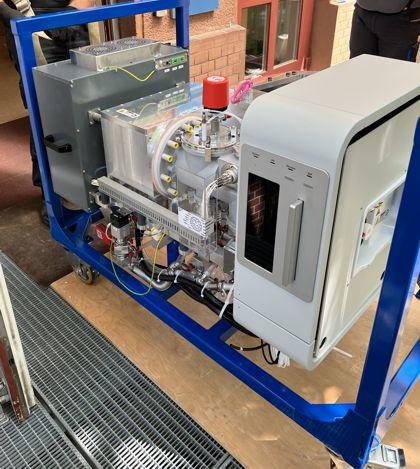
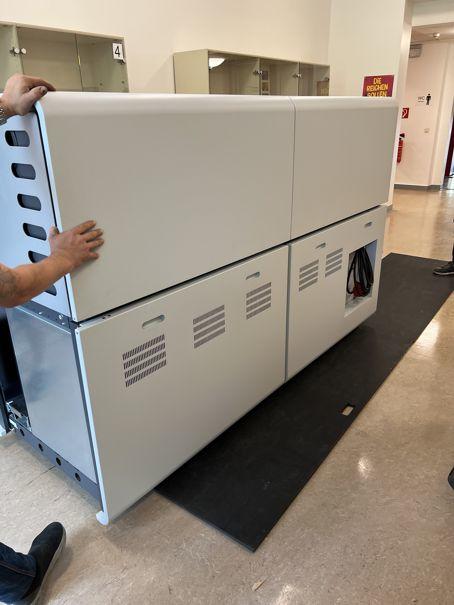
Transport of the multi-collector module |
|
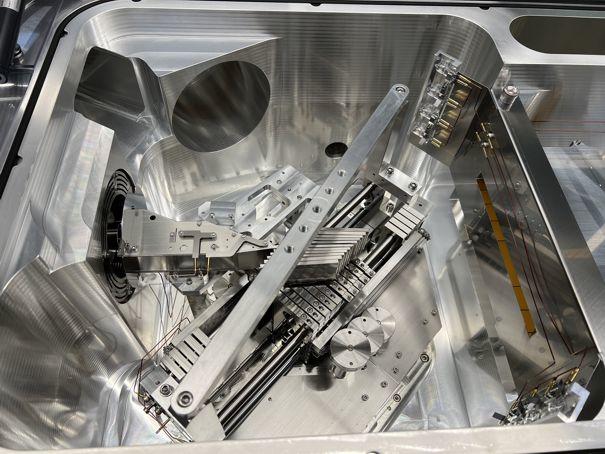
Optical bench of the multi-collector module with one fixed center channel and 10 movable collector supports |
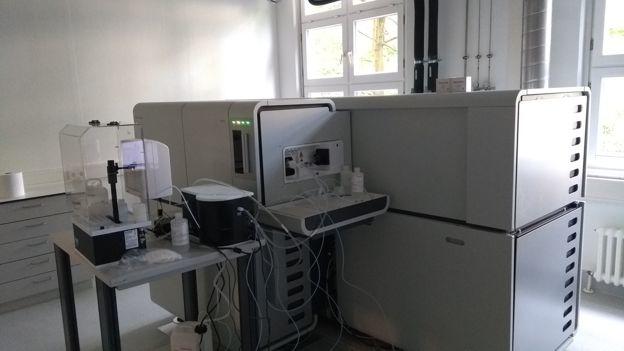
Neoma Multi-collector ICP-MS (ThermoFisher Scientific) equipped with Apex Omega desolvator (Elemental Scientific) and SC-μ DX autosampler (Elemental Scientific) |